
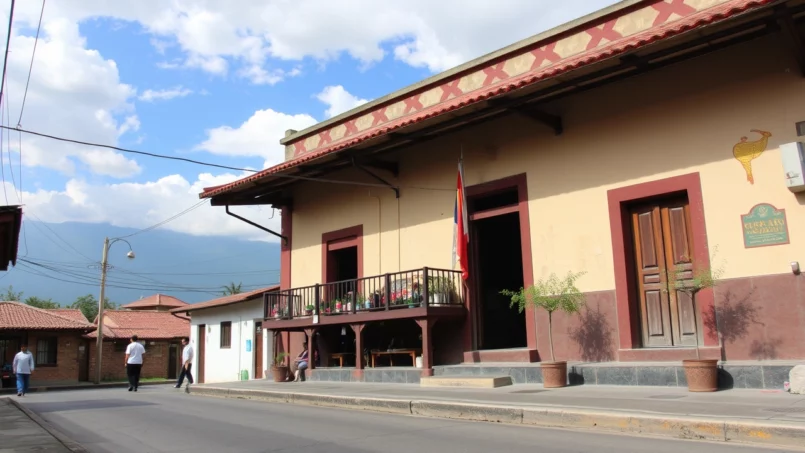
 Published on and written by Cyril Jarnias
In the heart of Central America, Guatemala is quietly emerging as one of the most dynamic markets for vacation rentals. Between the cobblestone streets of Antigua Guatemala, the shores of Lake Atitlán, and the trendy neighborhoods of Guatemala City, the country combines rapidly growing tourist flows, still-affordable real estate, and a relatively flexible regulatory framework for hosts. Behind the postcards of volcanoes, Maya markets, and colonial cities, the numbers tell a different story: that of a short-term rental market capable of delivering gross returns exceeding 12% in the best spots.
Good to know:
Antigua Guatemala is one of the most profitable markets in the country for vacation rentals. This article provides property owners and investors with a comprehensive analysis of the potential, risks, key figures, and successful strategies for this market.
A tourism market in full boom
The overall context clearly favors vacation rentals. Guatemala, often called the “Land of Eternal Spring,” is breaking tourism records. In 2024, more than 3 million international visitors were recorded, an increase of about 15% over the previous year, with revenues exceeding $2 billion. Tourism now accounts for hundreds of millions of dollars in annual revenue and nearly 60,000 jobs linked to air arrivals.
5685
Number of active short-term rental listings in Guatemala, 94% of which are on Airbnb.
Travelers are no longer satisfied with hotels. They seek more “lived-in” experiences, stays in local neighborhoods, encounters with residents, and immersion in the culture. That’s exactly what colonial house rentals in Antigua Guatemala, villas on Lake Atitlán, and urban lofts in Guatemala City offer. This shift in demand toward “home stays” creates a rare window of opportunity for property owners.
Why Antigua Guatemala is at the center of the action
If there is one market that illustrates the potential of vacation rentals in Guatemala, it is Antigua Guatemala. The former capital, a UNESCO World Heritage colonial enclave, ticks nearly all the boxes: tourist appeal, architectural heritage, proximity to La Aurora Airport (about 40 km), a significant expat community (around 3,000 foreign residents), and real estate dynamism.
An already massive supply volume, but promising
The most detailed data show the scale of the phenomenon. In the city of Antigua Guatemala alone, there are about 2,760 vacation rentals listed, of which 2,700 are equipped with Wi-Fi. In the historic center, there are already 235 short-term rental properties, divided into 44 houses and 67 apartments. In other words, the market is already well-established, but far from saturated, judging by occupancy rates and price growth.
On platforms like Airbnb, there are between 1,569 and 1,612 active listings depending on the source, with a very high share of entire homes: 62.1% of listings are entire homes, and more than half (54.2%) are standalone houses. Small accommodations remain dominant, but the inventory is diverse: nearly a third of listings are one-bedroom units, and properties with three or more bedrooms still account for 28.8% of the market.
140,000
Total number of verified reviews for vacation rentals in Antigua, indicating strong traveler interest.
Performance figures that are hard to ignore
Beyond volume, the performance indicators for Antigua Guatemala place the city in the top tier of short-term rental markets in Central America.
Several data sets converge:
– The median monthly revenue of a property is around $932.
– The top 10% of properties exceed $3,750 per month.
– The median nightly rate is around $74–80, but the best properties, especially in the historic center, easily command rates of $250 and more.
– A typical property is booked about 197 nights per year, more than half the year.
– Rental yield projections reach 12.3% gross annual yield, with a “rent gap” exceeding 30%, indicating a still-significant gap between potential rents and purchase values.
80
The top 10% of well-managed vacation rental properties frequently exceed this annual occupancy rate.
For large houses, often targeted by groups and families, the dynamic is similar: median occupancy of 35–45%, 58–68% for the upper quartile, and over 80% for the top 10%. In short, a well-positioned product rents regularly, even with a high nightly rate.
Seasonality: peaks that make the difference
As in most tourist markets, demand in Antigua Guatemala is highly seasonal. The most lucrative period is between November and April, the dry season. Statistics estimate that 60 to 70% of annual revenue for many rentals comes during this window.
March, boosted by Semana Santa and its spectacular processions, is often the most profitable month. The year-end holidays and April complete these demand peaks. Conversely, June, July, and especially September – right in the rainy season – show marked troughs, with occupancy rates sometimes halved.
Tip:
The strong variation in demand by season requires rigorous management discipline, including dynamic pricing and fill strategies during off-peak periods. On the flip side, it offers a significant advantage: during peak months, the most attractive properties can increase their rates by 25 to 40% above median levels, while maintaining very high occupancy rates.
Real estate that appreciates year after year
The other side of the equation is real estate itself. Antigua Guatemala has become one of the most expensive markets in the country, but the trend remains upward. Since 2020, prices have been rising by an average of 4 to 6% per year, and forecasts still predict 3 to 5% annual appreciation until 2027.
Colonial houses in the historic center are the best example. Between 2020 and today, price ranges have climbed sharply: where a restored house sold for between $180,000 and $350,000, you now need to budget between $250,000 and $500,000 for a quality property. Modern apartments have followed suit: the range has gone from about $65,000–$140,000 to $85,000–$200,000 for well-located units.
Even raw land is soaring. The price per square meter has gone from about $30–120/m² in 2020 to a current range of $50–200/m². Beyond houses and apartments, luxury villas on the outskirts of Antigua trade between $300,000 and $800,000, while some multi-property investment packages can reach $1 million.
The table below summarizes the typical price levels around Antigua Guatemala for different property types:
| Property Type | Current Price Range (USD) | Notable Recent Change |
|---|---|---|
| Colonial house, historic center | $250,000 – $500,000 | Strong increase since 2020 ($180,000 – $350,000) |
| Modern apartment | $85,000 – $200,000 | Up from $65,000 – $140,000 in 2020 |
| Development land | $50 – $200/m² | Marked progression from $30 – $120/m² |
| Luxury villa on outskirts | $300,000 – $800,000 | Expanding premium segment |
| Building / commercial space | $120,000 – $400,000 | Driven by tourism and commerce |
| Multi-property investment packages | $300,000 – $1,000,000 | Target structured foreign investors |
For investors, Antigua thus combines two performance drivers: solid rental cash flow and capital appreciation following the market trend.
Examples of properties that illustrate the potential
To understand how this potential translates concretely, just look at some emblematic listings.
Large group houses and colonial villas
Colonial or contemporary houses that can accommodate large groups are among the most profitable in high season. For example:
– Casa JoStella, sleeping up to 12 guests with 5 bedrooms and 2 bathrooms, priced at $355 per night (over $1,000 for 3 nights) and rated 10/10 on initial reviews.
– A “House in an exclusive safe and nice condo”, 5 bedrooms, 3+ bathrooms, for 10 people, listed at $272 per night.
– Another large house, “Walk to downtown Beautiful villa”, 5 bedrooms and 5 bathrooms, 10 beds, offered at $246 per night with more than 50 reviews and a perfect rating.
Example:
Vacation rental properties targeting extended families, groups of friends, or private events (like retreats or intimate weddings) can achieve significant profitability. With rates exceeding $200 per night and high occupancy during the dry season, some generate between $2,000 and $4,000 in monthly revenue during high season.
Charming accommodations and highly profitable small formats
At the other end of the spectrum, the city is full of studios, lofts, and tiny houses that are very profitable thanks to lower acquisition costs and steady demand from couples, upgraded backpackers, and digital nomads.
Examples include:
– The “Tiny home Antigua”, a designer small house with a mezzanine bedroom, steps from the main attractions. Despite the lack of parking, this type of property remains highly sought after thanks to its style and location.
– A “Comfortable loft in downtown Antigua Guatemala”, just 60 meters from the central park, with 250 Mbps fiber Wi-Fi and free parking a few streets away.
– “La Casa del Centro – the closest to central park”, also 60 meters from the park, 80 Mbps Wi-Fi, free parking 5 blocks away.
– “Saffron Luxury Apartment”, in the Plaza del Arco complex, a few meters from the Santa Catalina Arch.
$150,000
Investment amount sometimes less for acquiring smaller guest house formats in Antigua Guatemala.
Unique properties and “Instagrammable” experiences
The Antigua market particularly values unique experiences. The success of listings such as:
– “Festive Roof Patio | Jacuzzi | Two Blocks to Park”, located in a 250-year-old building with a private jacuzzi, a terrace that can accommodate more than 30 people, and volcano views, or
– “WOW! Casa Pyramid – Mayan inspired Retreat/Avo Farm”, a pyramid-shaped retreat on a property with hiking trails, a short distance from town,
shows that travelers are willing to pay a high premium for photogenic places, steeped in history or close to nature. In this vein, a cabin like “Cabin Tierra & Lava”, with simultaneous views of the Agua, Acatenango, and Fuego volcanoes, embodies what many tourists seek: spectacular setting and a “timeless” feeling.
Mapping neighborhoods and profitable areas
Not all streets in Antigua Guatemala offer the same potential. Revenue analyses show significant differences depending on the neighborhood.
The historic center: premium by design
The historic heart – around the Parque Central, the cathedral, the Santa Catalina Arch, the convents, and colonial museums – concentrates the highest rents and best nightly performance. It is here that prices of $80 to $200 per night become the norm for entire homes, with peaks well above that for exceptional properties.
Attention:
The main advantage of living in the city center is its walkability to all services (monuments, nightlife, spas, cafes, restaurants, schools, and markets). However, this involves very high purchase prices, potentially significant noise pollution, and strict regulatory constraints related to historic buildings.
Nearby periphery and Zona 1: value for medium or long stays
Around the historic core, areas like northern Zona 1, the vicinity of Cerro de la Cruz, Santa Ana, or San Francisco offer a very interesting compromise for medium and long-term stays: more affordable rents, a more “local” neighborhood feel, while still within walking distance or a short tuk-tuk ride from the center.
Good to know:
Areas outside the historic center are recommended for long-term rentals. The historic center is primarily intended for high-turnover vacation rentals.
Rural periphery and neighboring villages
Further out, areas like San Miguel Dueñas, Ciudad Vieja, or Jocotenango, as well as gated communities on higher ground (San Pedro el Alto, Santa Ana, Santa Inés, etc.), offer properties that are often more spacious, with gardens and volcano views, at much lower prices than the center.
Examples of houses in guarded residential communities, 10–15 minutes from the center, with garden, parking, and sometimes a shared pool, show that it is possible to target both local clientele (weekends, family events) and international guests (retreats, quieter stays). The trade-off is the almost systematic need for a car.
Returns, cash flow, and costs: what the numbers say
Promises of profitability only hold if you factor in the expenses. Nationally, vacation rental investments in Guatemala show theoretical gross returns between 6.6% and over 12%, depending on the city and property type. In Antigua Guatemala, top properties clearly exceed this ceiling, with documented cases where annual rental income reaches $14,000–$15,000 for medium-sized properties, or even more for large houses.
But expenses are far from negligible. For a typical host, the main cost items are as follows:
Monthly operating costs for an Airbnb rental
An overview of recurring costs to anticipate for managing a vacation rental, including operational expenses, services, and commissions.
Cleaning fees
Between $15 and $25 per turnover. For 15 to 20 monthly bookings, this represents a budget of $300 to $500.
Utilities and services
Costs for electricity, water, gas, and internet, typically around $50 to $120 per month.
Routine maintenance
Around $75 to $175 per month. May be higher with a garden, pool, or older building.
Consumables and amenities
About $20 to $40 per month for basics like soap, coffee, etc.
Platform fees
Airbnb charges about 3% commission on the host side. Travelers pay about 14% in service fees.
Accounting and taxes
Often $20 to $50 per month for handling paperwork and local declarations.
Professional management
If outsourced to an agency: between 10% and 20% of revenue, or sometimes $400 to $600 per month.
In the end, operational costs can eat up between 35 and 50% of gross revenue. For Antigua Guatemala, even after this trimming, the best properties manage to generate net returns of 6 to 8% or more, which remains very competitive compared to classic long-term rentals (4–6% net).
The table below summarizes, on a indicative basis, the typical performance orders of magnitude observed for a standard property in Antigua Guatemala:
| Property Profile in Antigua Guatemala | Estimated Monthly Revenue (USD) | Typical Occupancy Rate | Approximate Net Yield* |
|---|---|---|---|
| Market median | ~$930 | 39–54% | 4–5% |
| Upper quartile (Top 25%) | $1,800 – $2,500 | 60–65% | 6–7% |
| Top 10% (historic center / exceptional properties) | $3,700 – $4,000+ | 80–90% in high season | 8% and above |
Approximate net yield, after operating expenses but before taxes and financing.
Legal framework, taxation, and procedures for operation
The regulatory climate is one of Guatemala’s strengths. Nationwide, specific rules for vacation rentals remain relatively flexible. There is not yet a widespread licensing system like the “Airbnb registration number” in some European cities. But that doesn’t mean there are no rules.
Registration and local obligations
Hosts must comply with several obligations:
Attention:
To rent out a property in Guatemala, it is mandatory to register with the tax authority (SAT) to obtain a NIT and to declare your income monthly. In tourist areas like Antigua Guatemala, registration with INGUAT and collection of tourist taxes may also apply. Additionally, it is essential to respect specific condominium regulations regarding short-term rentals.
In terms of taxation, rental income is subject to the Guatemalan income tax regime. Effective rates for rental activities are often between 5 and 7% of profits, depending on the chosen regime and possible deductions. For non-resident owners, higher flat rates (up to 25%) may apply to certain types of income, but appropriate structuring (local company, formal accounting) often allows optimizing this aspect.
Purchasing a property and acquisition costs
For a foreigner looking to enter the Antigua Guatemala market, the acquisition process remains relatively simple:
Good to know:
Foreigners can buy without general restrictions, except near borders and coasts (not applicable in Antigua). A local attorney is mandatory to secure the transaction, draft the deed, and verify property titles. A 10% deposit is customary. Costs include a transfer tax of about 3% of the price and attorney fees (1.5–2%). For colonial buildings, budget 3 to 5% of the annual value for maintenance, insurance, and taxes, due to their fragility. Renovations on historic houses often cost between $30,000 and $80,000.
Most purchases are made in cash or via private financing, as local banks generally require 35–40% down payment for foreigners, with rates between 6 and 10%.
How does Antigua compare to the rest of Guatemala?
Guatemala is obviously not just Antigua Guatemala. Other vacation rental markets stand out, each with its own characteristics.
Guatemala City: the hub for business and urban travelers
The capital has more than 2,600 to 3,000 Airbnb listings depending on the source. Apartments and condos dominate the supply (over 85%). One-bedroom units account for nearly half the market, and most properties accommodate two to four people.
Performance is solid but less spectacular than in Antigua Guatemala: median revenue around $550–$560 per month, top 10% around $1,450–$1,470, median occupancy close to 40%, and top 10% above 80%. Gross returns generally range between 5 and 8% depending on the neighborhood (Zona 10, Zona 4, and historic Zona 1 being the most interesting).
Good to know:
Rental demand is more stable throughout the year, as it is mainly driven by business travelers, students, and short-term expats. This clientele mitigates the typical seasonality of purely tourist destinations.
Lake Atitlán: nature, retreats, and ecotourism
Another major hub: the Lake Atitlán region, with villages like Panajachel, San Marcos La Laguna, San Pedro, Santa Cruz, and Santa Catarina Palopó. Gross returns there range between 6 and 10%, with rents per square meter generally lower than in Antigua Guatemala. However, some municipalities record impressive average monthly revenues, such as Santa Catarina Palopó, where figures show over $2,900 in average monthly revenue for only about fifty properties.
Tip:
The clientele in this region seeks longer stays and has strong demand for eco-friendly accommodations, yoga retreats, and isolated lodges. However, infrastructure is generally less developed, which can lead to higher maintenance and remote management costs.
Other niche markets
The country has other pockets of opportunity: the Pacific coast (Monterrico, El Paredón), secondary cities like Quetzaltenango, Flores (gateway to Tikal), or beach areas like Puerto Quetzal. Some of these, heavily focused on large group villas, have extremely high average nightly rates but with more modest occupancy rates. Investment there is more speculative and strongly depends on the ability to differentiate and connect to the national market (Guatemalan clients) as much as the international one.
Compared to these markets, Antigua Guatemala benefits from a rare balance: massive tourist flow (about 1.2 million visitors per year), strong international image, stable foreign community, liquid real estate market, and proven rental performance.
What type of investor is Antigua Guatemala suitable for?
Vacation rentals in Antigua Guatemala are not for all profiles. The entry ticket, renovation requirements, and operational intensity can be barriers. However, for certain profiles, the city is a prime target.
Yield and appreciation-oriented investors
Those seeking a mix of rental yield and potential capital gains will be hard-pressed to find better in the region. With gross returns that can exceed 12% on the best operations and annual price appreciation of 4–6% for several years, the return-on-investment horizon can fall between 3 and 6 years for the best-performing properties. More conservative profiles will look at 7 to 10 years to break-even, especially on luxury properties requiring heavy renovations.
Owner-occupiers and “semi-residents”
Many expats or Guatemalans from the diaspora adopt a hybrid model: they buy a house or apartment in Antigua Guatemala, occupy it for several months a year, and rent it out the rest of the time as a vacation rental. This scheme allows them to finance a significant portion of the ownership cost while having a foothold in one of the country’s most attractive cities.
Structured and multi-property investors
Investment packages between $300,000 and $1 million, including multiple units in a single development or a portfolio of houses and apartments, clearly target institutional or semi-professional investors. They rely on economies of scale, shared management (often outsourced to a specialized operator), and a branding strategy on booking platforms.
Risks not to underestimate
No market is without risk, and Antigua Guatemala is no exception.
Several pitfalls emerge from field experience and data:
Good to know:
Vacation rentals in Guatemala, especially in Antigua, present specific challenges. High rental fees in some neighborhoods, like Antigua, can significantly reduce profitability. Marked seasonality requires adapted pricing to avoid extended vacancies. It is imperative to provide an international standard of comfort (Wi-Fi, hot water, bedding), which represents an initial investment. The national security context requires a careful choice of neighborhood, secure access, and clear information for travelers. Finally, regulatory changes, linked to UNESCO status and the sector’s growth, could introduce new constraints (quotas, taxes, standards).
How to maximize your chances of success in Antigua Guatemala
Given the level of competition, jumping into vacation rentals in Antigua Guatemala without a strategy is risky. A few key strengths stand out from the data and best practices observed in the country.
A property that is ideally located (historic center or immediately adjacent neighborhood) with good storytelling (colonial architecture, volcano views, intimate patio, rooftop, etc.), equipped with fast Wi-Fi, a full kitchen, and a workspace attracts both classic tourists and digital nomads.
The choice of services – self check-in, secure parking when possible, professional cleaning, availability of tours or local experiences – allows you to stand out in a city where the average rating already hovers around 4.7/5.
Good to know:
Dynamic pricing management is essential to maximize revenue. In Guatemala, the average daily rate (ADR) has slightly decreased, but overall revenue has increased thanks to better optimization of occupancy rates. In Antigua, using analytics tools allows adjusting rates according to real demand: avoid discounting high-season nights too early and fill gaps in low season.
Finally, the ability to build a brand of your own – direct booking website, active social media presence, base of loyal customer emails – reduces dependence on platforms and consolidates occupancy rates over the long term.
Conclusion: a promising but demanding market
The opportunities for vacation rentals in Guatemala are very real, and Antigua Guatemala probably embodies the best compromise between profitability, legal security, and market depth. With an already dense supply of over 2,700 rentals, prices that are rising but still attractive for an international investor, high occupancy rates, and robust tourist flow, the city positions itself as one of the leading markets in the region.
Tip:
To turn the potential of vacation rentals into concrete success, it is essential to manage it rigorously. This involves a careful study of neighborhoods, a rigorous calculation of costs, anticipation of seasonality, strict compliance with legal obligations, and a constant desire to stand out by offering a service superior to the already high standard in the city.
In other words, Antigua Guatemala will not reward those who simply put an average property online with a few blurry photos. But for investors willing to play the card of quality, experience, and serious management, the city today offers one of the most attractive combinations of return and enjoyment in Central America.

Cyril Jarnias is an independent expert in international wealth management with over 20 years of experience. As an expatriate himself, he is dedicated to helping individuals and business leaders build, protect, and pass on their wealth with complete peace of mind.
On his website, cyriljarnias.com, he shares his expertise on international real estate, offshore company formation, and expatriation.
Thanks to his expertise, he offers sound advice to optimize his clients' wealth management. Cyril Jarnias is also recognized for his appearances in many prestigious media outlets such as BFM Business, les Français de l’étranger, Le Figaro, Les Echos, and Mieux vivre votre argent, where he shares his knowledge and know-how in wealth management.





